NC Court of Appeals Rejects Partisan Gerrymandering Lawsuit Challenge
Appeals court rules that voter challenge to GOP-favored legislative maps raises questions beyond judicial authority.

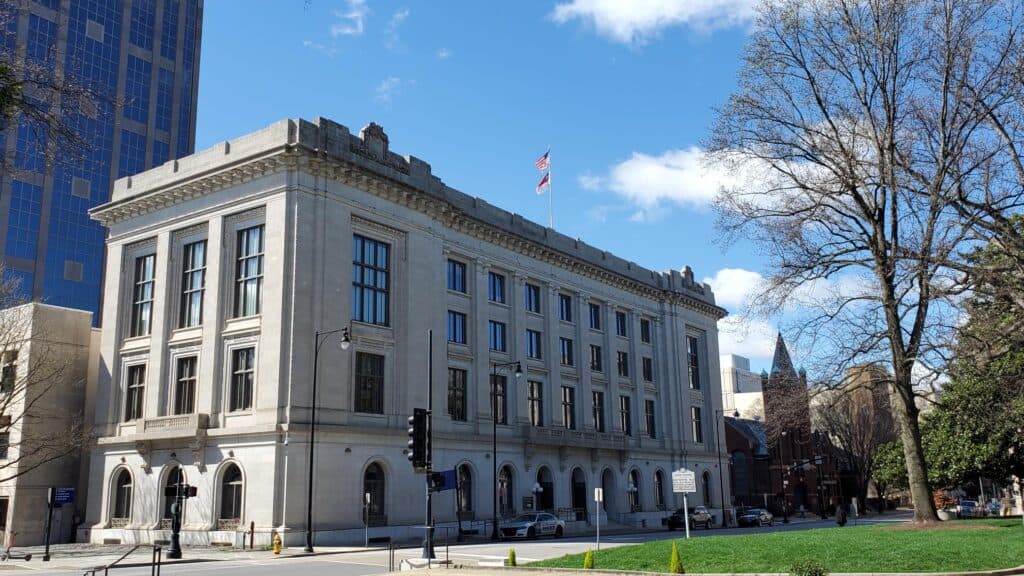
RALEIGH, NORTH CAROLINA — The North Carolina Court of Appeals dismissed a lawsuit challenging partisan gerrymandering in legislative districts, ruling that voter objections to the maps raised questions beyond the court’s jurisdiction.
The court upheld a lower court decision rejecting claims brought by 11 voters who challenged the constitutionality of state and federal legislative districts drawn by the General Assembly in 2023. The voters argued the maps were designed to heavily favor Republicans and violated an implicit constitutional promise of fair elections.
Court Finds Political Questions Beyond Judicial Authority
Judge Chris Freeman wrote in a 13-page unpublished opinion released Wednesday that the lawsuit’s central claim fell outside state court authority. The judge determined the case was “at its core an allegation that the General Assembly acted to change districts to give one party or group an advantage in the upcoming election.”
“Plaintiffs rely on an unenumerated right to fair elections as the limitation on the General Assembly’s authority to gerrymander on a partisan basis,” Freeman wrote. “Because we review whether the General Assembly violated an express provision of our constitution, plaintiffs’ reliance on an unenumerated right cannot be the basis for an unconstitutional act of the General Assembly.”
Former Justice Leads Constitutional Challenge
Former Republican state Supreme Court Justice Bob Orr represented the voters in their constitutional challenge. The plaintiffs argued that North Carolina’s constitution contains an implicit guarantee of fair elections, without which other fundamental rights would become meaningless.
Orr said in an interview Thursday that the challenge brought “a straightforward constitutional question that the courts have a responsibility historically to decide.” He described this as the most important case he has participated in during his 50 years of practicing law.
The court also rejected a separate request by legislative leaders to require the plaintiffs to pay the state’s attorneys’ fees.
Broader Context of Gerrymandering Disputes
Both the U.S. Supreme Court and North Carolina Supreme Court have previously ruled that partisan gerrymandering issues fall outside their jurisdiction. The latest decision continues this pattern of courts declining to intervene in legislative redistricting disputes based on partisan advantage.
The State Board of Elections and the General Assembly’s leadership did not respond to requests for comment on the ruling.
The 2023 legislative districts remain in effect following the court’s decision to dismiss the constitutional challenge. The maps were drawn after Republicans gained control of redistricting following changes in state Supreme Court composition and previous rulings on gerrymandering authority.