Black Voters Drop NC Senate Districts Lawsuit After Supreme Court Ruling
Two Black voters ended their federal challenge to redrawn Senate districts after the Supreme Court made it harder to prove voting rights violations.

RALEIGH, NORTH CAROLINA — Two Black voters challenging North Carolina Senate districts have dismissed their federal lawsuit following a U.S. Supreme Court decision that weakened protections under the Voting Rights Act.
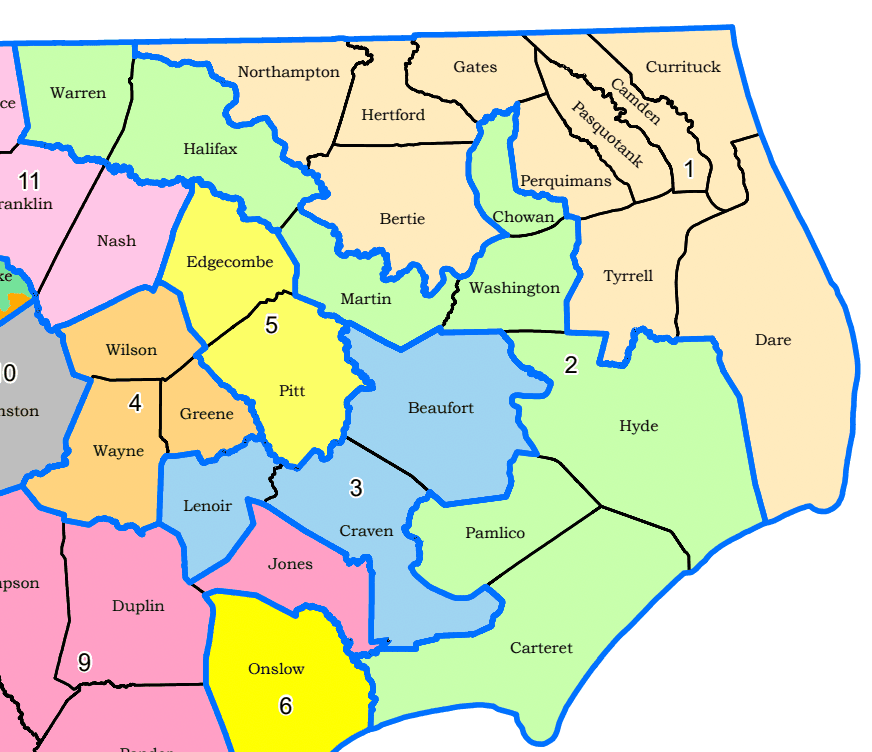
State Rep. Rodney Pierce (D-Halifax) and Moses Matthews had sued Republican legislators over their 2023 decision to redraw districts in eastern and northeastern North Carolina. The plaintiffs argued the new boundaries diluted Black voting power by breaking up “Black Belt” counties and preventing Black voters from electing candidates of their choice in Senate District 1 and Senate District 2.
Lawyers for Pierce and Matthews filed a notice of dismissal Monday, ending their legal challenge that had wound through federal courts for nearly three years.
Supreme Court Decision Changes Legal Landscape
The dismissal follows the Supreme Court’s April 29 ruling in Louisiana v. Callais, which altered how voting rights cases can be pursued. Under the new standard, challengers to election districts must prove they were drawn with the intentional purpose of discriminating against minority voters, rather than simply showing discriminatory effects.
“The U.S. Supreme Court’s Voting Rights Act decision left no path open to us to protect the voting rights of Black citizens in my part of the state,” Pierce said in a statement.
District Court Ruled Against Plaintiffs
The lawsuit had faced setbacks in lower courts before reaching the appeals process. U.S. District Judge James Dever ruled in favor of the Republican legislators last year, finding that the redrawn districts did not violate the Voting Rights Act.
Dever had previously denied a request from Pierce and Matthews to block the use of the contested districts in the 2024 election. After losing at the district court level, the plaintiffs appealed to the 4th Circuit Court of Appeals.
The original lawsuit contended that Republican legislators violated the Voting Rights Act when they reconfigured the northeastern districts during the 2023 redistricting process, which followed the once-per-decade redrawing of political boundaries based on census data.
Broader Impact on Southern Redistricting
The Supreme Court’s Louisiana v. Callais decision has triggered redistricting activity across southern states. Republican legislatures are moving to redraw districts that had been required under previous Voting Rights Act interpretations to ensure minority representation.
The ruling allows lawmakers to eliminate what were previously considered VRA-compliant districts that typically elected Democratic candidates and redraw them to favor Republican candidates instead.
Pierce represents Halifax County in the North Carolina House of Representatives, an area that includes part of the Black Belt region of eastern North Carolina known for its historically significant African American population.
The dismissed case highlights the ongoing tensions over voting rights and redistricting in North Carolina, where control of legislative and congressional districts has been heavily contested in recent years through both the courts and the political process.