Rick Jackson Defeats Trump-Backed Burt Jones in Georgia GOP Governor Primary
Rick Jackson outspent his rival nearly four-to-one in one of Georgia’s most expensive primary battles, defeating Trump-backed Lt. Gov. Burt Jones to claim the GOP gubernatorial nomination.

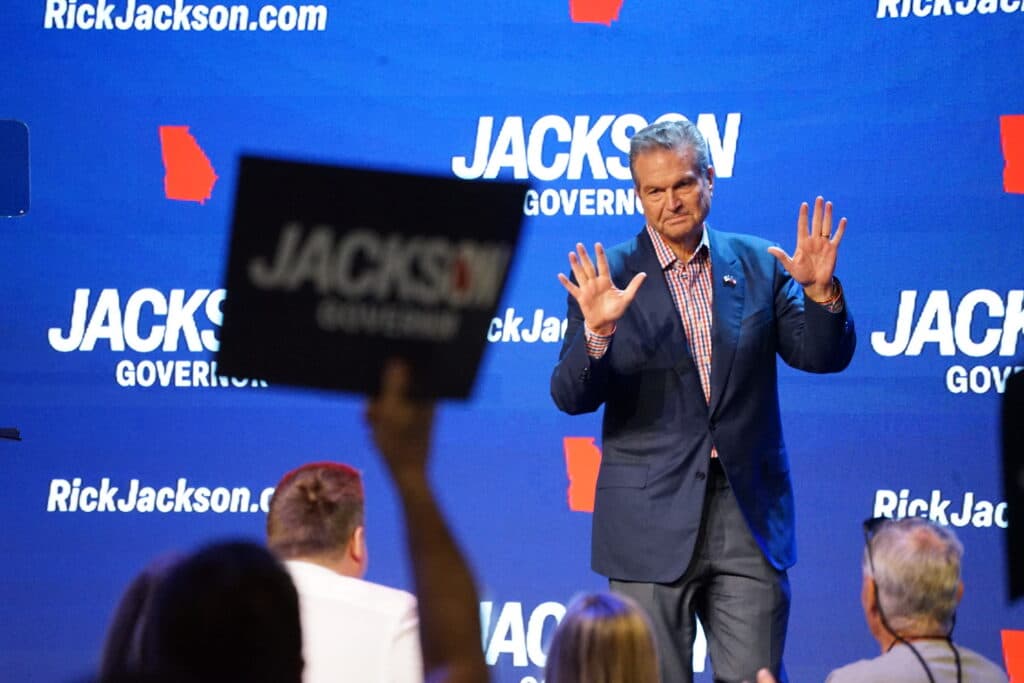
ATLANTA, GEORGIA — Wealthy businessman Rick Jackson won the Republican nomination for Georgia governor Tuesday night, defeating Lt. Gov. Burt Jones in a runoff election that the Associated Press called at 9:45 p.m. Jackson will now face former Atlanta Mayor Keisha Lance Bottoms in November’s general election.
Jones had entered the race as the frontrunner and carried the backing of President Donald Trump, but Jackson’s late entry into the contest in February changed the dynamics of the GOP primary. Jones also secured an endorsement from term-limited Republican Gov. Brian Kemp shortly before the runoff, but it was not enough to hold off Jackson.
A Race Defined by Big Money and High-Profile Endorsements
The two candidates combined to spend more than $138.6 million over the course of the primary and runoff period, according to campaign finance records. Jackson’s spending accounted for roughly 78% of that total, representing nearly $108 million — a figure largely drawn from personal contributions he made to his own campaign.
Jones, by contrast, loaned his campaign just over $25 million and raised an additional $5 million from outside contributors. Despite the massive advertising expenditures by both sides, which frequently targeted each other, Jackson ultimately prevailed.
Jackson drew support from several establishment Georgia Republicans, including Attorney General Chris Carr, who had previously run against him in the primary. Insurance Commissioner John King and outgoing Speaker Pro Tem Jan Jones also backed Jackson, as did national Republicans U.S. Sen. Rick Scott of Florida and U.S. Sen. Ted Cruz of Texas. Cruz appeared alongside Jackson at a rally in Alpharetta on June 15, 2026.
Jackson’s Outsider Strategy
Jackson positioned himself throughout the race as a political outsider, mimicking some elements of Trump’s campaign style. He made a flashy entrance at his campaign launch by riding down a glass elevator, a move intended to signal his status as a nontraditional political figure.
During the race, Jackson released an advertisement that implied he had the backing of Gov. Kemp, a claim Kemp later publicly denied. Kemp ultimately endorsed Jones before the runoff, citing electability as the reason for his decision to enter the endorsement contest.
What’s Next: The November General Election
Jackson now turns his attention to the November general election, where he will face former Atlanta Mayor Keisha Lance Bottoms, who secured the Democratic nomination. The race will determine who succeeds Kemp, who is barred from seeking a third term as governor.
Jones had been considered the frontrunner for much of the primary contest before Jackson announced his candidacy in February, according to the Georgia Recorder. Jackson’s entry immediately shook up what had been a largely settled Republican field.