NC Democrats Condemn Supreme Court Voting Rights Act Ruling, Republicans Applaud
Supreme Court decision in Louisiana v. Callais fundamentally changes how voting rights challenges can be pursued, with immediate implications for NC redistricting.

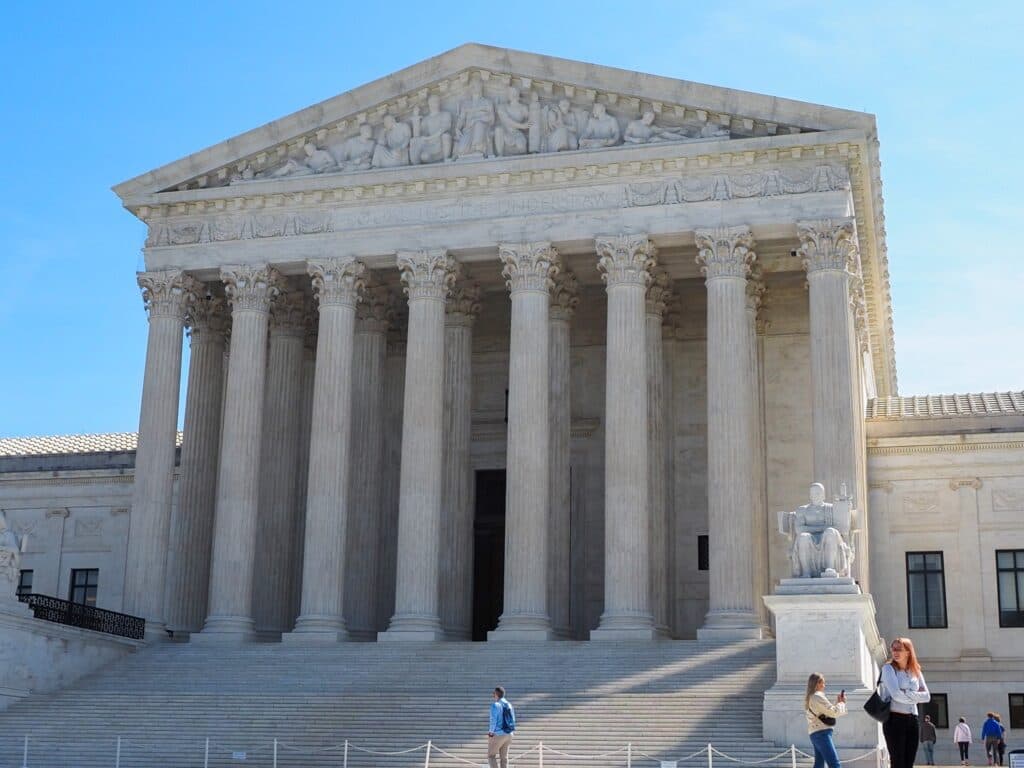
RALEIGH, NORTH CAROLINA — North Carolina Democrats condemned Wednesday’s U.S. Supreme Court ruling that significantly restricts the Voting Rights Act, while state Republicans praised the decision as a necessary check on judicial overreach.
The Supreme Court’s decision in Louisiana v. Callais Wednesday morning curtailed protections under the landmark civil rights law, limiting it to only prohibit voting maps drawn with explicit intent to racially discriminate against voters. The ruling changes how voting rights challenges can be pursued across the country.
New Legal Standard Raises Bar for Challenges
The majority opinion established that Section 2 of the Voting Rights Act now requires plaintiffs to “disentangle” race from lawmakers’ race-neutral considerations to draw a “strong inference” that race was a motivating factor in redistricting decisions. Previously, showing a racially discriminatory impact was sufficient to challenge voting maps.
Under the new standard, lawmakers can defend potentially discriminatory maps by claiming they drew districts to maximize partisan advantage rather than racial discrimination. Unless challengers can provide clear evidence of racial intent, such maps are presumed legal.
Justice Elena Kagan wrote in her dissent that the decision renders Section 2 “all but a dead letter,” endangering districts that provide minority citizens a “meaningful political voice,” particularly across the South.
Potential Impact on Minority Representation
“If other States follow Louisiana’s lead, the minority citizens residing there will no longer have an equal opportunity to elect candidates of their choice. And minority representation in government institutions will sharply decline,” Kagan wrote in her dissenting opinion.
Voting rights organizations Fair Fight Action and the Black Voters Matter Fund projected the ruling could enable Republican legislatures to redraw 19 districts previously protected by the Voting Rights Act, potentially flipping them to GOP control.
The decision carries immediate implications for North Carolina, where voters will have limited options to challenge the state’s new mid-decade redistricting map. Republican lawmakers drew the revised map in 2025 targeting the seat held by Rep. Don Davis (D-N.C.) in the 1st Congressional District.
State Political Response Splits Along Party Lines
The Supreme Court’s ruling drew sharply divided reactions from North Carolina’s political establishment. Democratic leaders characterized the decision as a devastating blow to voting rights protections that have safeguarded minority representation for decades.
Republican officials countered that the ruling appropriately limits judicial interference in the legislative redistricting process, arguing that courts had overstepped their constitutional authority in previous voting rights cases.
The decision represents the latest in a series of Supreme Court rulings that have weakened voting rights protections since the landmark 2013 Shelby County v. Holder decision eliminated preclearance requirements for certain states with histories of voting discrimination.
North Carolina has been at the center of numerous voting rights battles over the past decade, with federal courts repeatedly striking down legislative maps and voting procedures deemed discriminatory. The new Supreme Court standard will make such successful challenges significantly more difficult to pursue going forward.